
I was there in ’66 – 60th Anniversary edition – episode 7
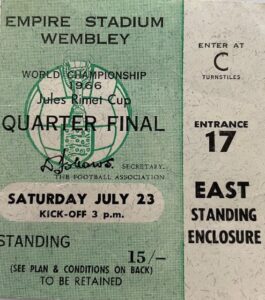
England: Banks, Cohen, Wilson, Stiles, Charlton J, Moore, Ball, Hurst, Charlton R, Hunt, Peters
Argentina: Roma, Perfumo, Marzolini, Ferroiro, Rattin, Albrecht, Solari, Gonzalez, Artime, Onega, Mas
Referee: R Krietlein (West Germany)
Attendance: 90,584
The England changes from the France match were to bring back Alan Ball to replace Ian Callaghan and to call up Geoff Hurst as the replacement for Jimmy Greaves, who had still not recovered from his badly gashed shin. Significantly, Ramsey had finally abandoned the use of a recognised winger altogether, and you sensed, somehow, this was finally his team.
This was always going to be a tough match as the highly skilled Argentinian team had enjoyed excellent wins against Spain and Switzerland in addition to a stubborn, but impressive, 0 – 0 draw against West Germany. They had conceded only one goal in their three previous games.
They had also displayed a level of cynicism that had not gone unnoticed, and this was referred to by Alf Ramsey when he, rather undiplomatically, said, ‘England players must not respond to the Argentines foul play,’ in his pre-match interview, on the evening before the game.
This created the wrong sort of headlines the next morning and incensed not only the Argentine players but the entire Argentine nation whose government was to demand an apology for Ramsey’s distinct lack of tact and diplomacy.
Unsurprisingly, the Argentine team more than lived up to their billing and, during a brutal first half hour that witnessed blatant body checking, shirt pulling, spitting and deliberate trips and kicks coupled with histrionic dives whenever an Argentine player was fouled, the spectators grew increasingly angrier and more frustrated.
The shirt-sleeved crowd was both nervous and excited, but I was supremely confident before the game that we would win and, having seen Bobby Charlton’s performances against Mexico and France, I was convinced we had a world-class player of our own who could turn the game with his vision and explosive finishing.
It was a very hot day, and the temperature seemed to have risen several degrees since kick-off. ‘They certainly like some argy-bargy.’ I quipped, but nobody was smiling as the grim faced supporters continued to will England on.
The Argentinian captain was a big, strapping guy named Antonio Rattin. Not only was he an uncompromising defender but was also a highly talented footballer with excellent ball control and passing ability. Rattin was finally booked for a trip on Bobby Charlton, as he attempted to reduce the effectiveness of England’s playmaker. The fussy, West German referee, Rudolph Krietlein, was doing his best to assert his authority on the game against considerable intimidation from the Argentine players and Rattin in particular.
England often threatened but failed to create any clear-cut chances and support started to wane from the booming chanting and singing there had been at the outset.
The supporters were now becoming engrossed in the match that, in our jingoistic eyes, pitted the honest sportsmanship of the English against the ruthless cheating and thuggery of the Argentinian players
When Krietlein booked another Argentinian, Luis Artime, for dissent, late in the first half, Rattin was incensed and angrily confronted the referee who, to everyone’s amazement, suddenly sent him off!
The totally frustrated referee, who must have been struggling to find breath in the hot and humid atmosphere that had seen him blow his whistle a staggering number of times, had simply had enough of being bullied by Rattin, who had been attempting to boss the game his way.
All England supporters were mightily glad to see the back of him and not just because it increased our odds of winning if they were reduced to ten men. The fact was, Rattin had also been driving his team and his runs out of defence and astute passes were leaving us severely stretched.
Shockingly, Rattin refused to leave the pitch and continued to confront the referee. A mêlée ensued that saw most of the Argentine bench come onto the field and remonstrate with the referee and this created a highly charged atmosphere that could have turned very nasty.
After a delay of eight minutes, the Police finally stepped in and escorted Rattin from the pitch, and he was noisily booed off by the crowd
This was somewhat relieved when the spectators took up the rather incongruous chant of: ‘corned beef, corned beef, corned beef,’ and this rang around the stadium continuously. This was a reference to a recent health scare relating to Argentinian beef and perfectly captured the English sense of humour and I joined in enthusiastically.
Somehow, this ridiculous chant relieved the tension and served to relax the crowd who had been snarling viscously at the Argentine tactics, until then, but were now once again full of good-natured banter
England took control of the game in the second half as the Argentines began to look tired and dispirited following the departure of the inspirational Rattin. However, several half chances went unconverted and the crowd, who had become more jovial since the corned beef taunts, again became concerned that events were not going to plan. When Argentina broke away to fire an attempt just wide of the post, I began to think the inconceivable, that we could lose to ten men in a match that we had dominated. It just wouldn’t be fair, would it?
When Geoff Hurst headed home Martin Peters’ astute cross for England’s late second-half winner – the relief was immense. After enduring an agonising final ten minutes in which Onega, the Argentinian midfielder, came close to creating an equaliser on two occasions, the noise at the final whistle was thunderous. Suddenly chants of: ‘we’re gonna win the cup,’ were starting to ring out and much of the pre-tournament optimism of Alf Ramsey was being shared by many others.
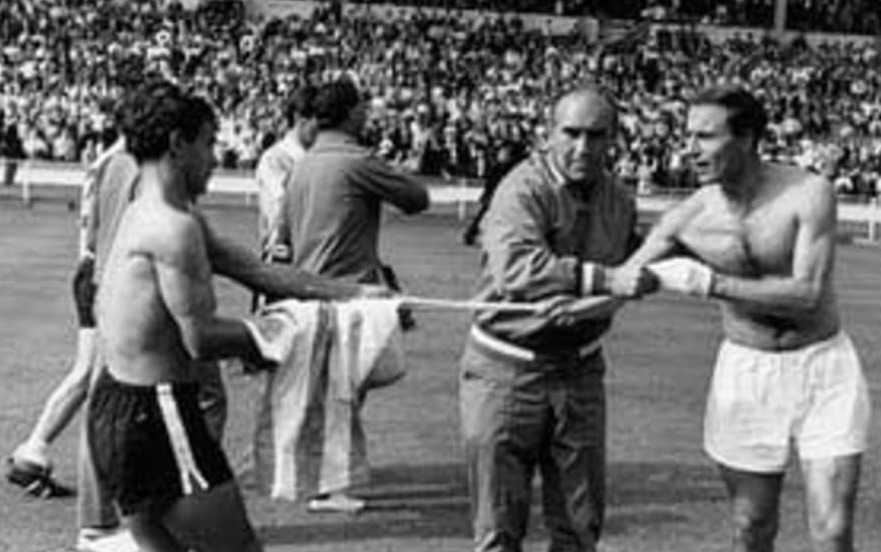
‘Animals’ was how Alf Ramsey had contentiously described the Argentinian team after the match at the end of which he had, famously, refused to allow the England players to swap shirts with the opposition.
The euphoria of the crowd spilling onto the Wembley streets for joyous Saturday night celebrations was infectious: Everywhere people were smiling and patting each other on the back in mutual congratulation of England’s success.
Cries of: ‘England, England’ filled the streets and total strangers were embracing each other with joy, and a feeling of bonhomie existed all around. I stood amongst the heaving crowd as we exited the stadium, trying to savour the moment…England were in a World Cup semi-final.